

Offline Mode
Your inspections don't stop, even if the internet does.





PropertyLenz Blog
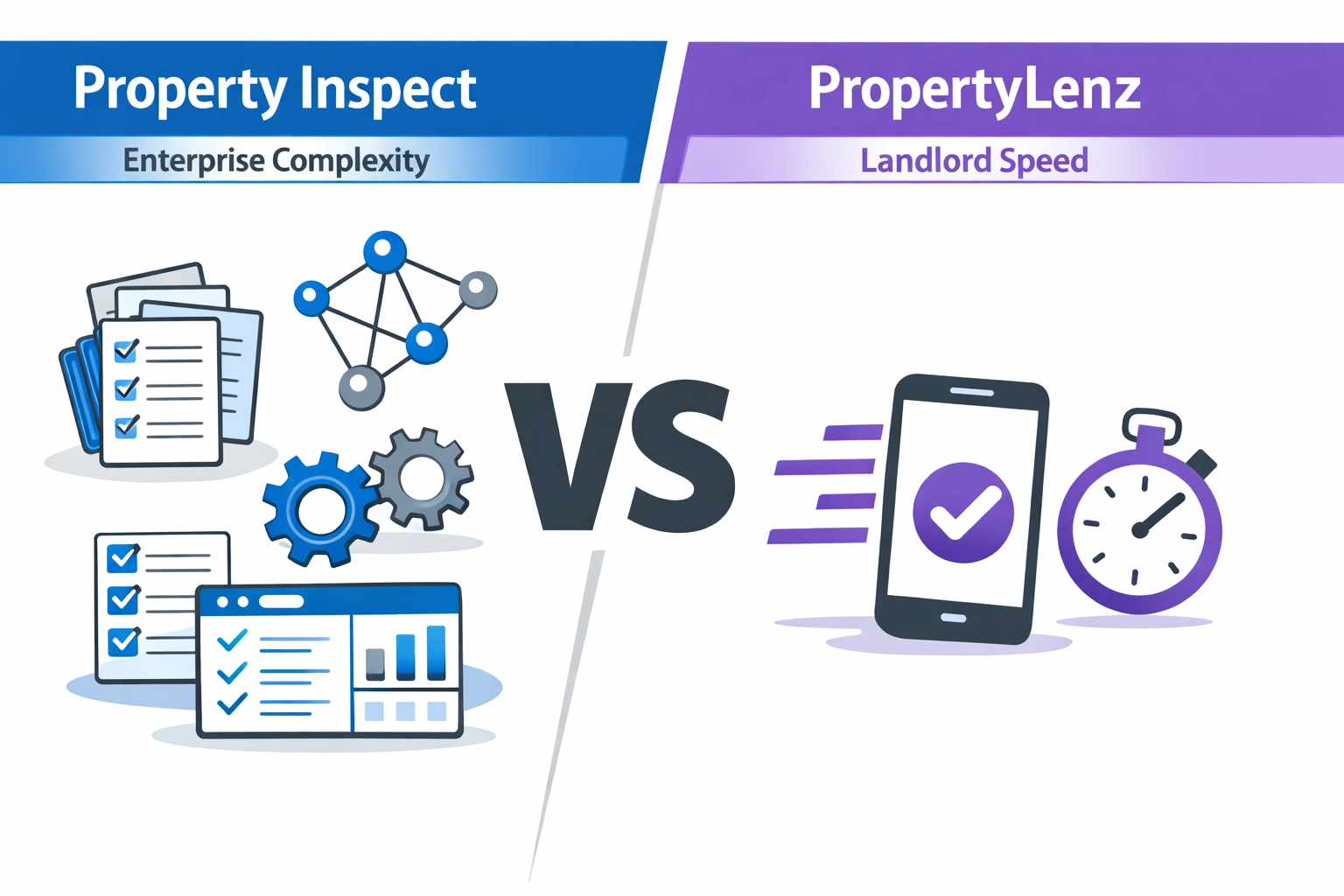
Property Inspect VS PropertyLenz: Enterprise Complexity or Landlord Speed?
Not all property inspection apps are created equal. Some are built for enterprise property management firms juggling thousands of units, compliance audits, and integration requirements. Others are designed for landlords and small-to-mid-sized property managers who just want to finish a move-in inspection before lunch.
Property Inspect and PropertyLenz represent two fundamentally different philosophies in the property inspection software world. Understanding which architecture fits your needs can save months of frustration and thousands of dollars in licensing fees.
The Architectural Divide
Property Inspect launched in 2015 as a comprehensive property management and compliance platform. It’s designed for the corporate property management world: think large portfolios, enterprise integrations with systems like MRI Software and PayProp, and extensive compliance tracking. The platform bundles rental property management features alongside inspections: tenant screening, expense management, owner portals, and risk assessments.
PropertyLenz takes the opposite approach. It’s a laser-focused property inspection app built around one core promise: complete an inspection on-site in under 20 minutes and generate a PDF-ready report before leaving the property. No tenant screening modules. No expense tracking dashboards. Just fast, mobile-first inspections designed for landlords who manage their own properties or small PM firms handling 3 to 300 units.

The difference isn’t about which platform has more features: it’s about architectural intent. Property Inspect prioritizes breadth and enterprise integration. PropertyLenz prioritizes speed and on-site completion.
Who Property Inspect Is Built For
Property Inspect serves property management companies overseeing larger portfolios where compliance documentation is non-negotiable. If a firm manages 500+ units across multiple states, deals with corporate landlords who demand quarterly compliance reporting, or needs inspection data to plug into broader operational systems, Property Inspect’s architecture can make sense.
The platform’s strength is scope. Inspections sit inside a bigger “operations” ecosystem that can include dashboards, scheduling, issue tracking, and add-on modules. That breadth can be valuable for teams that want one platform to support multiple functions and are willing to invest in rollout and process change.
However, that same enterprise design introduces tradeoffs for smaller teams. More features typically means more settings, more templates to standardize, and more training to keep field staff consistent. Property Inspect also publishes pricing that starts at $49/month for a Solo plan and scales up to $595/month for an Enterprise plan (with optional paid add-ons), which can feel steep when the only goal is fast, consistent documentation for turnovers. For landlords and small portfolios, the learning curve and cost can become “corporate overhead” rather than day-to-day value.
Who PropertyLenz Is Built For
PropertyLenz was designed for the landlord completing a move-out inspection on a Tuesday morning between tenant showings. The entire interface is optimized for speed: customizable checklists that eliminate redundant data entry, one-tap photo annotation, offline mode that works in basements with no cell signal, and PDF generation that happens on the device: no waiting for server processing.
The platform’s pricing model reflects its target audience: free for up to 3 properties, then $5 per month for every 10 properties added. A landlord managing 20 units pays $10 monthly. A property manager overseeing 100 units pays $50. No enterprise licensing tiers. No hidden implementation fees.
PropertyLenz accomplishes in 20 minutes what traditional pen-and-paper inspections take 90+ minutes to complete. The time-saving calculator isn’t marketing fluff: it’s based on documented inspection completion times from property managers conducting two-bedroom, one-bathroom unit inspections.
The Speed vs. Scope Tradeoff
Property Inspect’s comprehensive feature set appeals to organizations that need a single platform for multiple property management functions. Inspections feed into maintenance work orders. Work orders generate expense reports. Expense reports roll up into owner statements. This interconnected architecture reduces data silos and manual data transfer between systems.
But integration complexity means slower field performance. Inspectors navigate multiple modules, sync data across enterprise databases, and often require desktop access to complete reports. For landlords conducting inspections themselves, this overhead doesn’t provide value: it creates barriers.

PropertyLenz strips away everything that doesn’t directly contribute to faster on-site inspections. The easy inspection forms use condition ratings (Normal, Satisfactory, Damaged, Immediate Attention, Not Applicable) that inspectors can tap in seconds. Photo annotation happens inline without switching to separate editing tools. Comments attach directly to specific inspection items, not buried in general notes sections.
The offline mode is genuinely indisputable: data syncs automatically when connectivity returns, but inspections never pause because of basement Wi-Fi. For landlords inspecting properties in rural areas or older buildings with spotty coverage, this isn’t a nice-to-have feature. It’s the difference between completing an inspection or rescheduling it.
Feature Comparison: What Each Platform Delivers
Property Inspect’s Strengths:
- Enterprise software integrations (MRI, PayProp)
- Comprehensive property management modules beyond inspections
- Risk assessment and compliance tracking tools
- Multi-property portfolio dashboards
- Tenant screening and lease management
PropertyLenz’s Strengths:
- Sub-20-minute inspection completion times
- Mobile-first interface optimized for on-site use
- Offline mode that works in no-connectivity environments
- Instant PDF generation on device
- Digital signatures for tenant acknowledgment
- Cloud storage with unlimited photo uploads
- Transparent per-property pricing model
Property Inspect wins on breadth. PropertyLenz wins on inspection-specific speed and mobile optimization.
Pricing: Enterprise Plans vs. Per-Property Transparency
Property Inspect publishes tiered subscription pricing that is closer to enterprise-style packaging than per-property simplicity. Plans start around $49/month (Solo) and scale to $595/month (Enterprise), with plan limits (users/properties) and optional paid add-ons depending on needs. For larger organizations that want a platform standard across teams, that structure can be workable.
PropertyLenz uses transparent per-property pricing that is easier to justify for small portfolios: free for up to 3 properties, then $5 per month for every 10 properties added. A landlord with 8 properties pays zero. A property manager with 45 properties pays $20 monthly. The pricing calculator removes the typical back-and-forth of packaging and quote math.
For landlords managing under 10 units, PropertyLenz’s approach is especially straightforward: low monthly cost, fast onboarding, and a focus on ironclad photo documentation (with tagged photos, item-level notes, and on-site report generation) without the extra layers that come with “all-in-one” operations platforms.
The Verdict: Match the Tool to the Job
Property Inspect serves enterprise property management firms that need comprehensive compliance tracking and system integrations across large portfolios. If inspection data must flow into corporate ERP systems, owner portals, and maintenance management platforms, Property Inspect’s architecture supports that complexity.
PropertyLenz serves landlords and small-to-mid-sized property managers who prioritize inspection speed and mobile accessibility. If the goal is documenting property conditions fast enough to complete reports on-site during tenant turnovers, PropertyLenz’s focused architecture eliminates unnecessary friction.

Neither platform is objectively “better”: they’re architected for different users with different needs. The question isn’t which inspection app has more features. The question is whether enterprise complexity serves your actual workflow, or whether it just slows down straightforward property inspections.
For landlords who’ve wasted 90 minutes filling out paper inspection forms in clipboard format, then another hour transcribing notes into Word documents, PropertyLenz represents an 80% time reduction that’s immediately noticeable. For enterprise property management firms integrating inspection data into complex compliance reporting systems, Property Inspect’s broader platform may justify the overhead.
The right choice depends entirely on whether speed or scope defines success for your property inspection workflow.
Recent Blogs
The Ultimate Guide to the Rental Condition Report: Everything You Need to Succeed
Published: April 29, 2026
Read More
How to Create a Pro-Level Rental Inspection Checklist in Under 5 Minutes
Published: April 27, 2026
Read More
Move-In vs. Move-Out Inspection: How to Create a Comparison Report That Ends Disputes
Published: April 24, 2026
Read More
Deposit Dispute Secrets Revealed: How Your Rental Condition Report Can Save You Thousands
Published: April 22, 2026
Read More