

Offline Mode
Your inspections don't stop, even if the internet does.





PropertyLenz Blog
Pet Damage vs. Normal Wear and Tear: What You Can Actually Charge For

Let me tell you about the day I discovered that a tenant’s dog had decided my brand-new mini-split cooling lines looked like the world’s most expensive chew toy.
I walked into the unit for a routine inspection, and there it was: a $3,500 HVAC system that had been “un-installed” by a 40-pound terrier mix. Copper lines twisted like pretzels. Refrigerant long gone. The dog? Sitting there wagging its tail like it had just fetched the newspaper.
That experience taught me something critical: the line between “pet damage” and “normal wear and tear” isn’t just blurry, it’s a legal minefield that can cost you thousands if you get it wrong.
So let’s clear this up once and for all, because I’m guessing you didn’t get into property management to become a forensic investigator for pet crimes.
The Golden Rule: Everyday Use vs. Negligence
Here’s the baseline: Normal wear and tear happens even when tenants treat your property like a museum. It’s the natural aging process that comes with humans existing in a space. Paint fades. Carpet wears down. Grout discolors.
Pet damage, on the other hand, happens because someone made a choice (letting Fluffy roam unsupervised, skipping potty training, ignoring the sound of scratching at 2 AM).
The distinction matters because you’re legally responsible for wear and tear repairs, but you can absolutely deduct pet damage from security deposits, as long as you can prove it.

What You CANNOT Charge For (Even If It Annoys You)
Let’s start with what doesn’t count as chargeable damage, even in pet-friendly rentals:
- Minor scratches on hardwood floors from nails clicking around during normal walking
- Small scuff marks on walls at tail-wagging height
- Pet hair left behind (yes, even if it takes you three hours to vacuum)
- Faded spots on carpet where a dog bed sat near a sunny window
- Dust and dander buildup on air vents
- Normal carpet wear patterns in high-traffic pet zones
If you allow pets in your lease, these are the trade-offs. They’re the equivalent of “minor nail holes” in a non-pet rental. Annoying? Sure. Chargeable? Nope.
What You CAN (And Should) Charge For
Now we’re talking. Here’s where pet damage crosses the line into “you’re paying for this”:
The Big-Ticket Items
- HVAC damage (like my mini-split massacre)
- Chewed baseboards, door frames, or window sills
- Carpet or flooring destroyed by urine (we’ll get to that story in a second)
- Scratched or gouged doors from aggressive pawing
- Torn screens or window treatments
- Severe odors that require professional remediation or replacement
The “Marketability Test”
Here’s a useful litmus test: If the damage would make a reasonable person hesitate to rent the unit at market rate, it’s chargeable.
Faint pet smell that Febreze can handle? Wear and tear.
Urine-soaked subfloor that smells like a kennel even after shampooing? That’s damage, my friend.

The Bedroom-Turned-Bathroom Story (Or: Why Documentation Saves Your Sanity)
Speaking of severe damage, let me introduce you to the second worst day of my landlord career.
A tenant abandoned a property mid-lease. When I showed up to assess the situation, I noticed the master bedroom door was closed. That should’ve been my first clue.
I opened it.
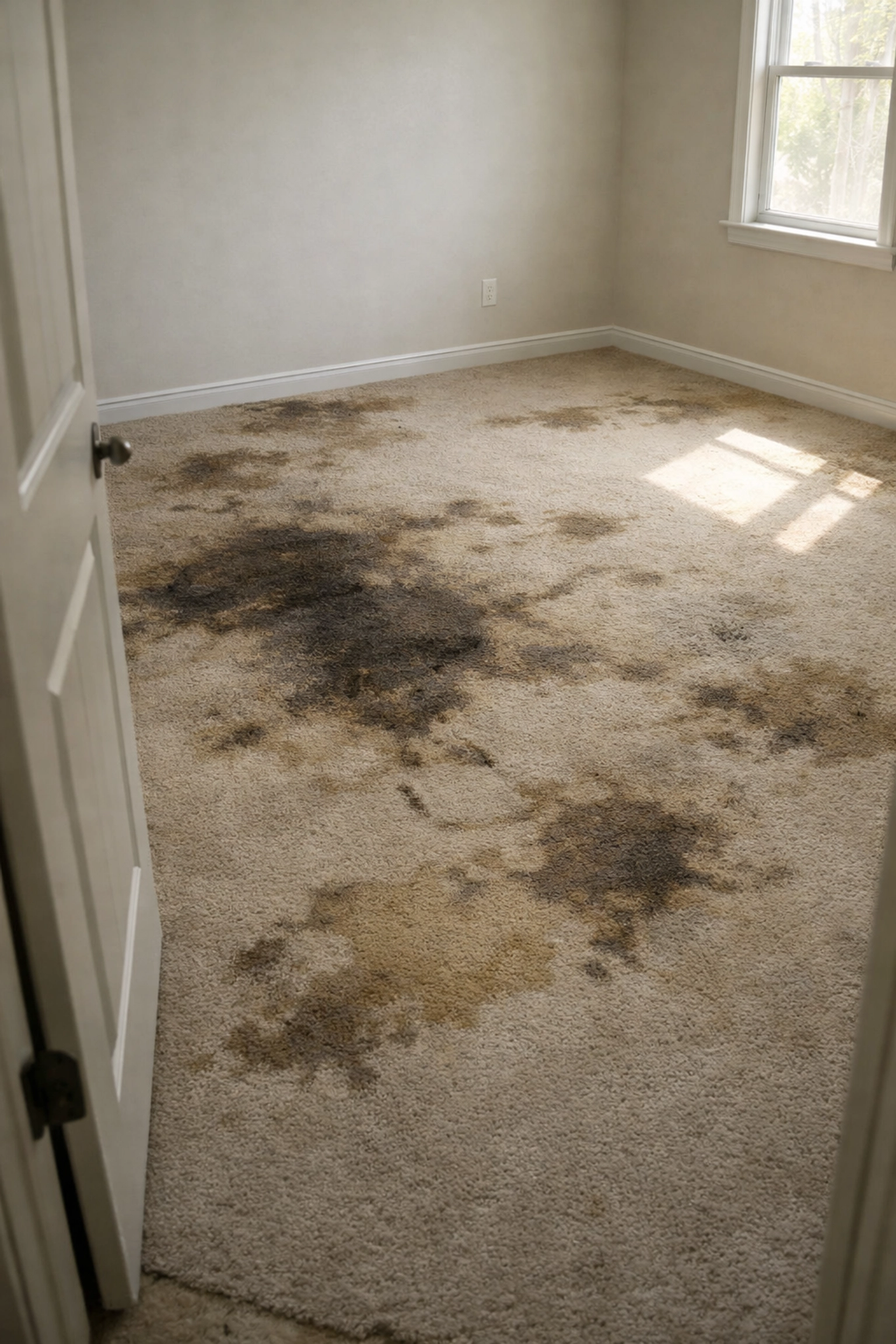
The carpet wasn’t just stained: it was saturated. The tenant had apparently let their dog use the entire bedroom as a personal bathroom for weeks, maybe months. The smell hit me like a physical wall. The padding underneath had basically composted. The subfloor had water damage.
Total cost to repair: $4,200 (carpet, padding, subfloor replacement, odor remediation, and two days of airing out the property).
Did I get compensated? Mostly. But only because I had a rock-solid lease that specifically outlined pet damage protocols and a detailed move-in inspection report that proved the room had been pristine when they moved in.

The Depreciation Rule (Or: Why You Can’t Charge Full Price for a 10-Year-Old Carpet)
Here’s the part that trips up a lot of landlords: You can only charge for the remaining useful life of a damaged item.
Let’s say your carpet has a 10-year lifespan, and it’s already 7 years old when Fido decides to redecorate. Even if the damage is 100% the tenant’s fault, you can only deduct 30% of the replacement cost from their deposit (because it only had 3 years of life left anyway).
Common Item Lifespans:
- Carpet: 5–10 years
- Paint: 2–3 years
- Vinyl flooring: 10–20 years
- Blinds: 3–5 years
- Appliances: 10–15 years
Do the math before you send that deduction letter. Otherwise, you’re inviting a small claims court headache.
Documentation: Your Only Defense in a Dispute
Let’s be honest: tenants don’t usually say, “Yep, my dog destroyed that. Here’s a check.”
More often, you get: “That stain was already there. That scratch was from the previous tenant. That smell? I don’t smell anything.”
This is where a rental property inspection report becomes your legal shield.
What You Need to Document at Move-In:
✅ Time-stamped photos of every room, every angle, every potential problem area
✅ Close-ups of carpets, walls, doors, and flooring (especially in pet-friendly units)
✅ Notes on existing wear patterns (“light scratches on kitchen door,” “minor stain near closet”)
✅ HVAC and appliance conditions (you’d be shocked how many “broken” mini-splits were “fine when I moved in”)
Then, repeat this exact process during your move-out inspection checklist walkthrough. Side-by-side comparisons are basically litigation kryptonite.
The 2026 Bulletproof Inspection Protocol
Here’s the thing: documenting pet damage properly takes time. You need the right photos, the right timestamps, the right organizational system so you’re not frantically searching through 400 iPhone photos when a tenant disputes a charge.
That’s why we built PropertyLenz to handle the heavy lifting.
Our rental condition report feature lets you create side-by-side move-in/move-out comparisons in under 10 minutes. You take the photos, we organize them. You note the damage, we timestamp it. You need proof three months later? We’ve got it stored in the cloud, ready to download.
No more “he said, she said.” Just facts, photos, and a PDF you can send to your lawyer, your tenant, or small claims court.
Want to see how it works? Check out a sample inspection report here.

Pet Deposits, Pet Rent, and Pet Fees: What’s the Difference?
Quick clarification, because this confuses everyone:
- Pet rent: Monthly fee ($25–$75/month) that covers the privilege of having a pet. It’s income, not held for damages.
- Pet deposit: Refundable amount (usually $200–$500) held specifically for pet damage. You return it if there’s no damage.
- Pet fee: One-time non-refundable charge ($200–$400) to cover general pet-related wear.
Here’s the catch: If you collect a pet deposit and a security deposit, some states limit what you can deduct from each. Check your local landlord-tenant laws before you send that deduction letter.
The Bottom Line
Pet damage isn’t normal wear and tear: but proving it requires documentation, knowledge of depreciation rules, and a lease that spells out your pet damage policy in excruciating detail.
The mini-split dog? I got compensated after filing a claim against the security deposit and sending the tenant a detailed breakdown with photos, receipts, and a depreciation calculation.
The bedroom bathroom? Took longer, but same outcome.
Both cases hinged on one thing: I had proof.
You can love dogs, cats, and exotic birds all day long. But when it comes to protecting your investment, your best friend isn’t Fluffy: it’s a properly documented move-out inspection checklist and the ability to prove what happened.
Start your free PropertyLenz trial and never second-guess a pet damage claim again.
Next up: We will tackle tenant abandonment protocols, step-by-step. Because apparently, my rental horror stories are the gift that keeps on giving.
Recent Blogs
The Ultimate Guide to the Rental Condition Report: Everything You Need to Succeed
Published: April 29, 2026
Read More
How to Create a Pro-Level Rental Inspection Checklist in Under 5 Minutes
Published: April 27, 2026
Read More
Move-In vs. Move-Out Inspection: How to Create a Comparison Report That Ends Disputes
Published: April 24, 2026
Read More
Deposit Dispute Secrets Revealed: How Your Rental Condition Report Can Save You Thousands
Published: April 22, 2026
Read More